
Ashwagandha Guide: Benefits, Dosage, Side Effects
Researchers respect Ashwagandha in both classical texts and clinical trials. This blog has knowledge about ashwagandha benefits, dosage, and side effects, and I also share my clinical experience on it. Known in Sanskrit as Ashwagandha. For centuries, practitioners have used this root to treat weakness, poor sleep, and low vitality.
Today, researchers are testing much of what Vaidyas observed at the bedside.
This guide covers what the tradition says, what the evidence shows, and how to use the herb safely.
Ashwagandha has long been used as a rasāyana and balya herb. It may help with stress and sleep, according to studies. Typical trial doses are 300–600 mg of standardised extract daily. Avoid use in pregnancy, and consult your doctor if you have thyroid or autoimmune conditions.
What is Ashwagandha
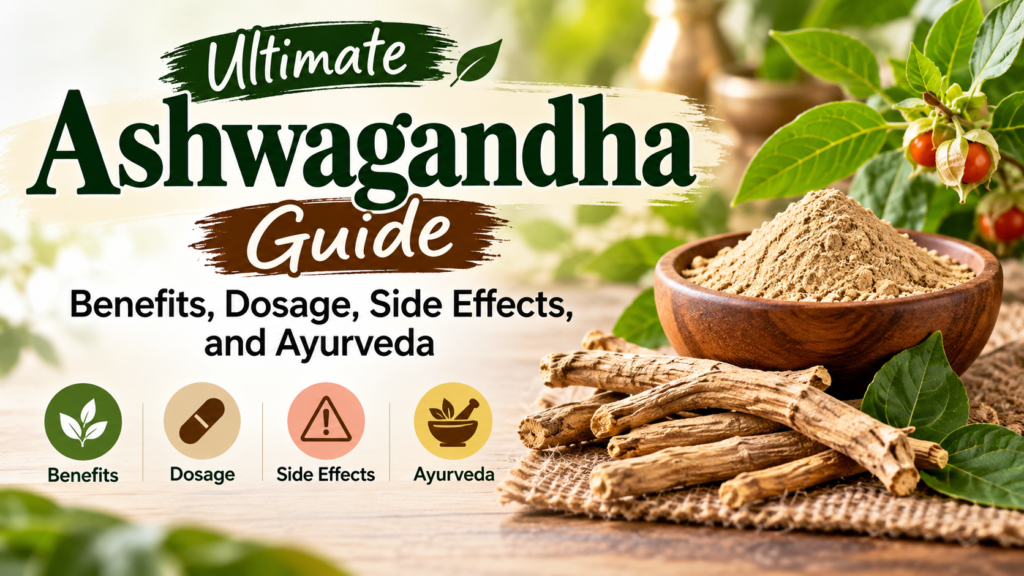
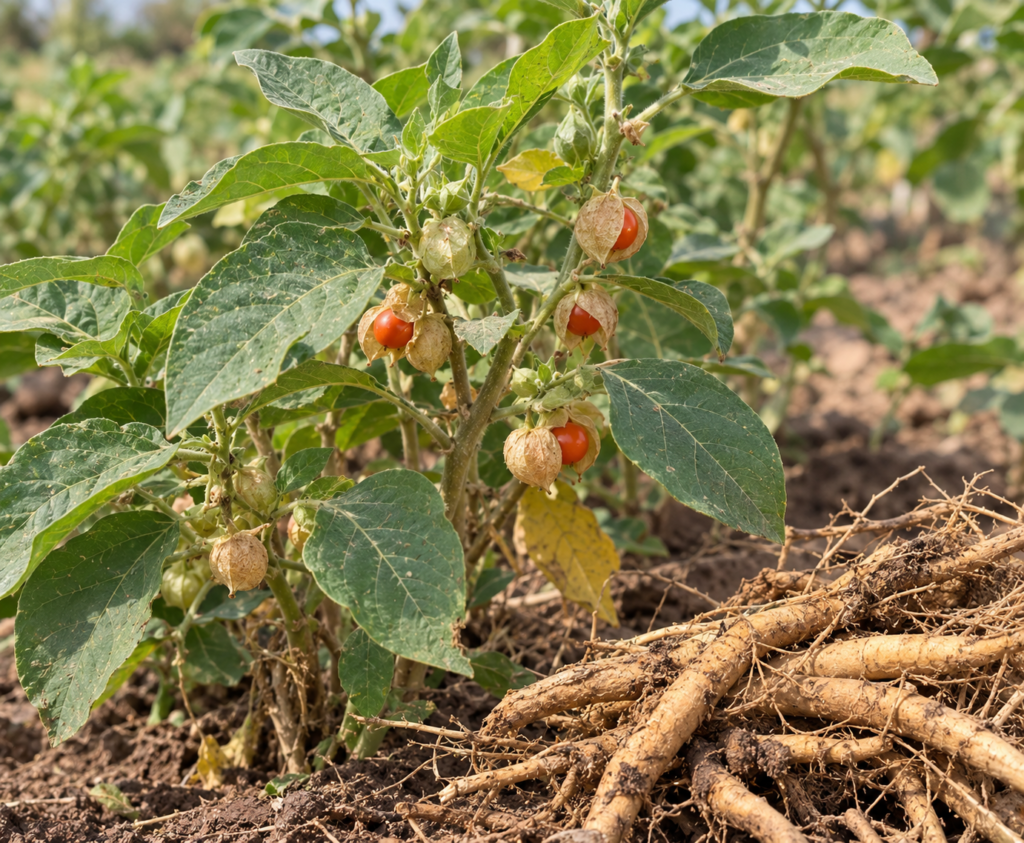
Ashwagandha (Withania somnifera) is a shrub of the nightshade family (Solanaceae). Thus, it is native to India and found across the Middle East and Africa. Additionally, the part used is the root (mūla). Moreover, the name joins ‘ashva’ (horse) and ‘gandha’ (smell). Additionally, this name reflects Ashwagandha: benefits, dosage, side effects and Ayurveda properties in traditional use.
Ayurvedic Properties of Ashwagandha
Ayurveda describes an herb through its dravya-guṇa profile rather than a single “active ingredient”.
| Parameter | Ashwagandha |
|---|---|
| Rasa (taste) | Predominantly tikta and kaṣāya |
| Guṇa (quality) | Laghu, Snigdha |
| Vīrya (potency) | Uṣṇa (heating) |
| Vipāka (post-digestive effect) | Madhura |
| Doṣa action | Pacifies vāta and kapha |
| Karma (actions) | Balya, rasāyana, vājīkara, nidrājanana, śothahara |
Because of its ushan vīrya, people with a strong pitta constitution should use it carefully and under guidance.
What Modern Research Says
The root contains withanolides (such as withaferin A and withanolide A), alkaloids and saponins. Additionally, it shows how classical actions align with what studies have looked at.
| Classical action | Modern correlate | Strength of evidence |
|---|---|---|
| Rasāyana | Lower perceived stress and cortisol in several trials | Moderate |
| Nidrājanana | Better sleep quality, mainly in people with insomnia | Small trials |
| Balya | Gains in muscle strength and recovery alongside resistance training | Small trials |
| Vājīkara | Improved semen parameters and testosterone in some men | Limited |
| Śothahara | Reduced inflammatory markers | Preliminary |
The honest summary: results are encouraging, especially for stress and sleep. However, many studies are short, small, and use branded extracts. Ashwagandha Properties supports well-being. It is not a cure for any disease.
How to Take Ashwagandha: Dosage and Forms
Traditionally, one takes about 3–6 g of the root powder (churna) with warm milk (kṣīra anupāna). Additionally, it may be taken with water, often at night. It also appears in ghṛta preparations and in formulations like Aśvagandhārishṭa.
Clinical trials usually use 300–600 mg per day of a standardised root extract for 8 to 12 weeks. Thus, a sensible approach is to start with a lower dose and adjust as needed.
- Start with a low dose and increase gradually.
- Take it with food to reduce stomach upset.
- Avoid open-ended, unsupervised long-term use.
- Ask a qualified Ayurveda doctor for a dose suited to your Prakriti and condition.
Side Effects and Who Should Avoid It
Ashwagandha is generally well tolerated for short periods. Some people notice drowsiness, loose stools or mild stomach discomfort.
Avoid it, or speak to your doctor first, if you:
- are pregnant or breastfeeding
- have a thyroid disorder or take thyroid medication
- have an autoimmune condition
- take sedatives or immunosuppressants
- are sensitive to nightshade plants
In my clinical experience, not a single case of liver injury has been reported. Always take after consultation with an Ayurveda doctor.
How to Choose a Good Product
Quality varies widely. Look for:
- clearly stated root-only content, or a labelled extract with its withanolide percentage
- third-party testing for heavy metals and contaminants
- a batch number and manufacturer details
- GMP or AYUSH certification
- no vague “proprietary blend”
Frequently Asked Questions
When is the best time to take ashwagandha?
Traditionally at night with warm milk, especially when sleep is the goal. Some people prefer mornings if it makes them drowsy.
What should it be taken with for the best results?
Shatavari and Kutki are best, which increases its absorption.
How long does ashwagandha take to work?
Most trials report changes after 4 to 8 weeks of regular use.
Can women take ashwagandha?
Yes, in general, except during pregnancy. It is not limited to men, despite its vajikaran reputation.
Is ashwagandha the same as ginseng?
No. Both are called adaptogens, but they are different plants with different profiles. Ashwagandha is called “Indian ginseng” for convenience only.
Final Thoughts
Ashwagandha shows how classical guṇa-karma thinking and modern pharmacology can describe the same herb in different languages. Used at the right dose, in the right person, it can be a valuable ally for stress.
Additionally, it supports sleep and strength.